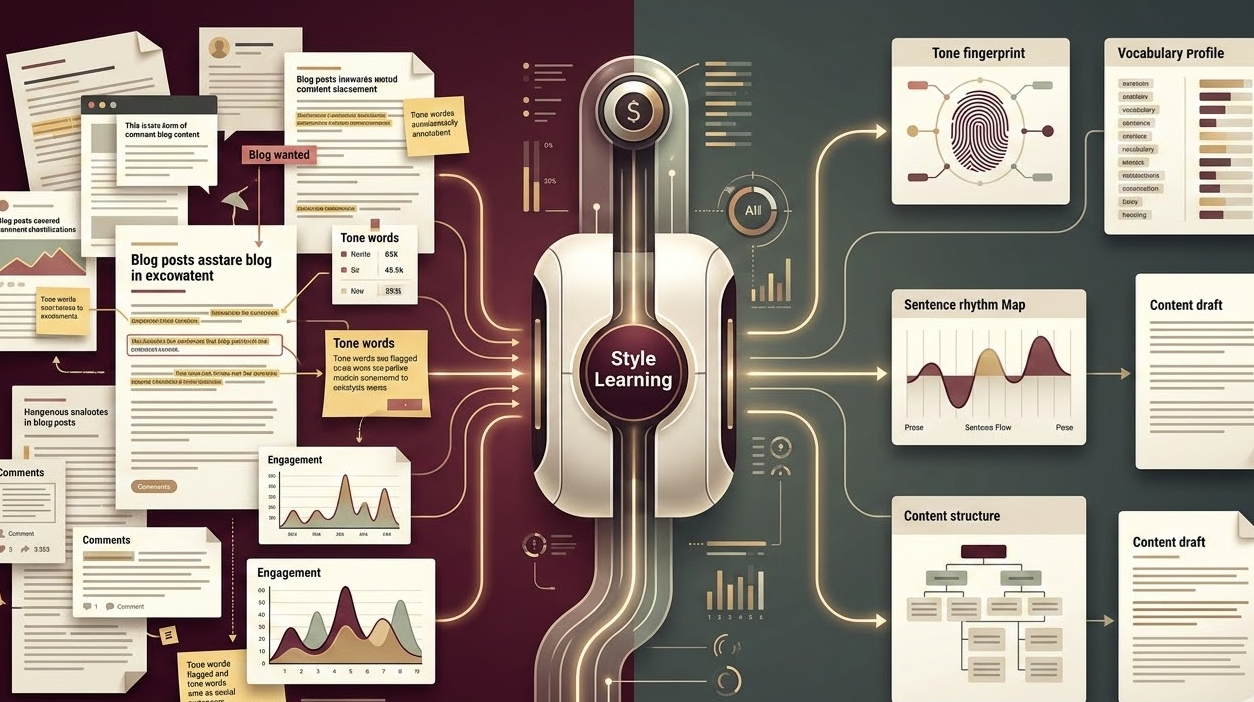
A practical guide to analyzing existing content for tone, structure, and engagement patterns — the same process Scribengine automates through its Style Learning pipeline.*
You've published dozens of blog posts. Maybe hundreds. Content analysis — the practice of reverse-engineering what makes your best work tick — is how you stop guessing and start repeating. But most creators never do it.
Some of those posts hit — shares, comments, people emailing to say "this is exactly what I needed." Most of them just... exist. They load, they sit, they collect zero traction, and you move on.
The maddening part? You can rarely tell in advance which will be which.
So you try things. You tweak headlines. You experiment with length. You write at 6am when the ideas feel sharper, or midnight when the perfectionism fades. Sometimes it works. Usually it doesn't seem to make much difference. And underneath all of it is a question you keep not quite asking: what is it about my best content that makes it work?
This is what content analysis actually solves. Not "audit your old posts and delete thin content" (though that's useful too). The real work is excavation — digging through your top-performing pieces to pull out the patterns, the tonal signatures, the structural habits, and the specific word choices that your audience unconsciously responds to. Those elements exist in everything you've written. They're just not labeled.
Here's the other thing most people never account for: generic AI tools can't find those patterns, because they don't know you produced them. Ask any standard AI writing tool to write a blog post "in your brand voice" and you'll get something technically passable, structurally safe, and distinctly... not you. Thousands of brands publish that same content every day under different logos. It works about as well as you'd expect.
What actually works is understanding your own voice well enough to replicate it deliberately — on demand, at scale, without drifting into generic territory every time a deadline gets tight. That's what we're going to work through together. By the end of this, you'll have a repeatable content analysis framework you can apply to any body of work, including your own. And you'll understand exactly why style learning changes what AI content can actually do.
Let's get into it.
Why Content Analysis Is the Skill Most Creators Skip
Content analysis sounds academic, which is probably why most content creators avoid it. The phrase calls to mind research papers and coding matrices and graduate students staring at spreadsheets. None of that is what we're talking about.
In plain terms, content analysis is simply the practice of reading your own (or your client's) existing work and asking structured questions about it. What writing tone does this use? What structural patterns show up consistently? What language choices appear again and again? What does this content assume about its reader? The answers form a picture — a kind of fingerprint — that separates your content from everyone else's.
The reason this matters more than most creators realize comes down to brand voice consistency. And brand voice consistency has measurable stakes.
According to Lucidpress research, consistent brand presentation across platforms can increase revenue by up to 23% — a number that should stop any content team mid-scroll. That's the compounding effect of audiences recognizing your brand's personality before they've even read the headline, trusting it because it behaves consistently, and converting at higher rates because the familiarity builds over time. Sprout Social data backs this up: consistent voice correlates with 23% more engagement across social channels, not because consistency is inherently interesting, but because inconsistency is jarring and people disengage when something feels "off."
Here's an uncomfortable truth worth sitting with: according to Edelman Trust Barometer data, only about 1 in 3 consumers say they trust most of the brands they use. That's a low baseline. Brand voice is one of the few direct levers you can pull to shift that number.
And the evidence isn't limited to consumer brands. Grants.gov offers one of the most concrete case studies available. When the federal agency adopted a deliberately approachable, consistent voice across its platform, user completion rates rose 29% and support escalations dropped 41%. That's a government agency — not a DTC brand with viral potential. If consistent voice moves those numbers there, the stakes for your content operation are real.
Tone Words and Writing Tone: What They Actually Mean
Before we get into the framework, two terms need clear definitions because they get used loosely everywhere.
Writing tone is the emotional quality of your content — how it feels to read, independent of the information it contains. Research from Northern Illinois University found that content written in a conversational human voice produced an 18% increase in factual knowledge retention and a 22% boost in trust scores compared to formal corporate tones. A piece about tax planning written warmly and informally feels completely different from the same information in distanced, formal prose — even if the facts are identical. Tone shapes whether your reader feels like they're being lectured, mentored, entertained, or spoken at.
Tone words are the descriptive vocabulary you use to define tone. Authoritative. Playful. Conversational. Dry. Urgent. Empathetic. Wry. These aren't decorations — they're functional labels that let a team of writers (or an AI system) produce content that behaves consistently. Goldman Sachs content uses tone words like "authoritative," "precise," and "formal." Airbnb's content uses words like "warm," "human," and "community-focused." Neither is better; they're calibrated to completely different audiences and purposes.
For solo creators, this matters because your writing tone is probably more consistent than you think — you just haven't documented it. For agencies managing multiple client voices simultaneously, it matters because without documented tone words, every writer on the team is making independent judgment calls, and those calls drift.
Website writing is where this becomes especially high-stakes. When someone lands on your site, they're forming an impression of your entire brand from a handful of pages. If your homepage sounds like a corporate press release, your blog sounds like a Reddit thread, and your product descriptions sound like they were written by a different company entirely — you've got a consistency problem that no amount of SEO optimization will fix.
Good content analysis is what turns "we have content" into "we have a voice."
The 5-Step Content Analysis Framework
This is the part you came for, so we're going to take it seriously. These five steps work whether you're analyzing your own blog post archive, auditing a client's content library, or trying to understand what makes a competitor's content tick. Do them in order the first time.
Step 1: Identify Your Top Performers
You can't reverse-engineer success if you're analyzing the wrong content. Start by pulling your top 10-15 pieces across whatever metrics matter most to your business. For most content creators, that means some combination of:
Organic traffic (Google Search Console or Analytics)
Time on page (a proxy for genuine engagement, not just accidental clicks)
Backlinks earned (an indicator of credibility and originality)
Social shares or saves
Conversion events — email signups, purchases, contact form fills tied to the page
Pick pieces that performed across at least two of those dimensions. A post that gets traffic but has a 12-second average time on page isn't a success; it's a bounce. A post that gets modest traffic but consistently converts visitors into subscribers is more interesting.
Aim for variety within your top performers. Include a mix of long form content that runs to 3,000 words alongside shorter posts and different topic areas if possible. What you're looking for are patterns that survive format changes — the elements that show up whether you wrote 800 words or a deep-dive that took a week to produce.
One practical note: if your content archive is small (under 30 pieces), use all of it. The patterns will still emerge; you'll just have less confidence they're statistically stable. That's fine — you're looking for signal, not writing a dissertation.
Step 2: Map Your Tone Fingerprint
Open your top five performers side by side. Read them back-to-back, specifically not for information — read for feel. Notice what emotional register they operate in. Are they reassuring or challenging? Do they treat the reader as a peer or a student? Is there humor, and if so, what kind — dry, warm, self-deprecating?
Then do the actual work: write down 5-8 tone words that describe what you're reading. Be specific. "Professional" tells you almost nothing. "Direct, empathetic, occasionally sardonic, never condescending" — that's a fingerprint.
Look for these signals in particular:
Formality markers: Contractions (it's, you'll, don't) vs. full forms (it is, you will, do not). Casual openers vs. formal constructions.
Relational distance: Does the writing treat the reader as an insider or an audience? Does it say "we" to mean "you and I together" or "we" to mean "our company"?
Confidence level: Does it hedge everything ("you might consider...") or make direct recommendations ("do this")?
Emotional temperature: Warm, cool, or neutral? Does the writing acknowledge that the reader might be frustrated, excited, or uncertain?
This is your tone fingerprint. Write it down. It's the most valuable output of this entire process, because it's the thing that makes every future piece feel like it came from the same person — even when it didn't.
Step 3: Decode Your Writing Style
Writing tone tells you how the content feels. Writing style tells you how it's built.
Look at sentence length distribution. Count sentences across three different paragraphs from each piece and note whether they're long and complex, short and punchy, or mixed. Most engaging writing mixes both — but the specific ratio is part of your style signature. Some writers default to long sentences with occasional short staccato breaks for emphasis. Others write mostly in short bursts with an occasional longer sentence for depth. Neither is better; both are identifiable.
Look at paragraph length. Does the writing breathe (2-3 sentences per paragraph), or does it build (5-6 sentences before breaking)? Does it ever use single-sentence paragraphs for emphasis?
Look at how examples work. Does the writing use hypothetical scenarios, real named examples, personal anecdotes, or data citations? The type of evidence preferred is a stylistic marker as much as a rhetorical choice.
Look at transitions. Some writing uses explicit connective language ("as a result," "building on this," "by contrast"). Other writing cuts from point to point without explanation, trusting the reader to follow. The presence or absence of those connective phrases creates a very specific rhythm.
And look at vocabulary level. Not formally — just read a few hundred words and ask: could a smart 15-year-old follow this? Or is it deliberately specialist? There's no right answer, but knowing your default vocabulary register tells you a lot about who you unconsciously believe your reader is.
Step 4: Reverse-Engineer Your Structure
This is the architectural analysis. Take three of your top performers and map them structurally:
How does the piece open? (A question? A problem statement? A data point? An anecdote?)
How does the first section establish stakes? (What's at risk if the reader ignores this?)
Where does the main framework or solution appear? (Early, midway, or built toward?)
How do sections close? (Summary? Transition? Cliffhanger into the next section?)
Where does any CTA or recommendation appear? (End only? Woven throughout? Multiple times?)
How does the piece end? (Resolution? Forward look? Question for the reader?)
What you're looking for is your default architecture — the unconscious structure you tend to reach for when you write. Most writers have one, even if they'd deny it. This structural mapping is especially revealing in long form content, where the architecture has room to breathe and your habits become unmistakable.
This matters for two reasons. First, your audience has internalized your structure and finds it satisfying — you've trained them. Second, when you drift from your structural defaults (or when a different writer produces content for you), readers sense the dissonance without being able to name it. The piece just feels "off."
Step 5: Identify Your Engagement Triggers
This final step requires you to go back to comments, social replies, emails, and save/share data — the messier qualitative layer on top of the quantitative metrics you used in Step 1.
When people respond enthusiastically to your content, what are they responding to? Look specifically for:
Comments that quote a specific line back at you
Shares with quoted text in the caption (this is gold — it tells you exactly what resonated)
Email replies that reference a particular section
Questions that stem directly from something you wrote
Cross-reference those specific elements with the content they came from. What format were those elements in? (A list? A specific phrase? An unusual data point? A personal admission?) What position in the piece did they appear? What tone was in play at that moment?
The data here aligns with broader research on personalized content. Studies show a 39% increase in click-through rates when content is tailored to specific audience behavior, and a 41% boost in engagement from dynamic content that responds to reader context. Your engagement triggers are the organic version of this — the intersection of what you do naturally and what your audience actually responds to. That's not the same as what you think your audience cares about. The data knows better.
The Framework in Action: A Real-Time Walkthrough
Let me show you what this looks like with a real example — a simplified blog post excerpt that a hypothetical small business owner (a fitness coach building an online following) might write:
Raw excerpt:
"Most people approach their fitness goals the wrong way. They focus too much on intensity and not enough on consistency. If you want real results, you need to stop chasing the perfect workout and start building the imperfect habit. A 20-minute workout you actually do beats a 90-minute program you skip twice a week."
Now let's run it through the framework:
Tone analysis: Direct, slightly challenging (opens with "wrong way"), empathetic (acknowledges the reader's real struggle), slightly aphoristic (ends with a quotable comparison). Tone words: direct, conversational, challenging, grounded, occasionally pithy.
Writing style: Short sentences (19, 14, 17, and 22 words respectively). Consistent paragraph rhythm — no sentence longer than 25 words in this excerpt. Uses "you" throughout — high relational proximity. No jargon. Vocabulary is 8th-grade level, intentionally so.
Structure pattern: Opens with a problem reframe, then delivers the core belief, then operationalizes it with a direct comparison. Classic "reframe → principle → proof" mini-structure.
Engagement triggers: The last sentence is the likely share trigger — it's quotable, concrete, and reassuring. It names the reader's fear (skipping) and reframes it as acceptable.
From this single excerpt, you now know: this writer's voice is direct, conversational, slightly contrarian, grounded in practical examples, and optimized for quotability. Every future piece of content — every blog post, every email, every social caption — should pass through that filter, whether a human writes it or an AI does.
That's the exercise. Do it with 10-15 pieces, and patterns emerge that you can actually act on.
The Value Gap: What Most Creators Miss
Understanding your voice is valuable. Consistently applying that understanding to every piece you publish is where most content operations quietly fall apart.
The realistic picture: a solo creator doing this framework correctly — gathering analytics, reading through content, mapping tone fingerprints, documenting structure patterns — is looking at 4-6 hours of focused work to build a usable brand voice profile. That's assuming a reasonably sized content archive (30+ pieces) and no significant distraction. Agencies doing this for a new client can spend 8-15 hours on discovery and voice analysis before a single word of content is written.
That's time well spent, once. The problem is "once" is never actually once.
Brand voice drift is what happens when the analysis doesn't inform every piece produced after it. You do the framework, document your tone words, write yourself a style guide — and then three weeks and a deadline later, you're writing a blog post at 11pm, tired, and the voice that comes out is... fine. Technically acceptable. But subtly different. A bit more formal, or less specific, or missing that characteristic dry aside that your audience recognizes as distinctly yours. One post doesn't matter. Five posts of gradual drift definitely does.
This is the crux of what makes content consistency hard. It's not a knowledge problem. Most experienced creators know what their writing style is. It's an execution problem — the gap between knowing your voice and reliably producing it under real-world conditions.
Here's the publishing context that makes this urgent: Orbit Media's 2024 research shows that 50% of bloggers who publish 2-6 times weekly report strong results, while average publishing frequency dropped slightly as brands shifted toward quality over quantity — and engagement surged nearly 20%. Translation: your audience rewards consistent quality, but producing consistent quality at any meaningful frequency is exactly where voice drift creeps in.
Why Generic AI Makes This Worse, Not Better
The temptation when facing an execution problem is to reach for a tool. Which is how millions of content creators ended up disappointed by their first experiences with AI writing tools — not because those tools are bad, but because they were reaching for a consistency solution that the tool wasn't designed to provide.
When you ask a standard AI to "write a blog post in a conversational tone about [topic]," here's what actually happens: the model pulls from a distribution of "conversational blog posts" across its training data and produces something that statistically resembles that category. It will be readable. It will be structured. It will use appropriate transitions and probably hit a reasonable keyword density. And it will sound indistinguishable from every other article targeting that keyword, because it was calibrated to a category, not to your specific voice.
This is the sameness problem — and it's a real one. When every brand using the same tool is targeting the same keywords with the same writing tone, the differentiating factor disappears. Your content becomes ambient noise in a feed full of ambient noise.
The context here matters: 78% of organizations now use AI in some capacity, up from 20% in 2017. That's not a gentle trend; that's a fundamental shift in how content gets produced. And 68% of businesses report increased ROI from AI in content marketing, according to 2024 industry research. AI works — when it's properly calibrated. The problem isn't the technology. It's the calibration.
The ROI math is worth being explicit about. A qualified freelance writer charging market rates for a 2,000-word SEO blog post will typically run $400–$800 for that single piece. For brands publishing four or more posts per month, that's $1,600–$3,200 per month in writing costs alone, before editing, strategy, or distribution. Generic AI brings that cost down dramatically — but if the output is consistently off-voice, you're paying to produce content that actively weakens your brand differentiation over time.
Scribengine sits between the DIY struggle and a full-service agency: you get agency-calibrated output without the agency timeline, discovery cost, or retainer commitment. The question isn't "AI or no AI." The question is: which AI approach actually solves the consistency problem?
How Style Learning Automates Content Analysis
Everything you just did manually in that 5-step framework — the tone fingerprinting, the structural mapping, the engagement trigger analysis, the vocabulary calibration — that's exactly what Scribengine's Style Learning pipeline does. The difference is time and precision.
Where the manual process takes hours per brand and requires trained judgment to execute well, Style Learning completes the analysis in minutes and codifies the outputs in a Company Profile that informs every piece of content generated after it. You do the framework once, and the system carries it forward consistently. It doesn't have a tired Wednesday.
Here's what the analysis actually looks at under the hood:
Tone and personality markers: The same signals you were reading for in Step 2 — formality level, relational distance, confidence calibration, emotional temperature. Style Learning quantifies these rather than leaving them to subjective interpretation.
Sentence and paragraph rhythm: The length distributions and structural patterns from Step 3. If your writing style typically uses short punchy sentences with occasional longer analytical beats, Style Learning captures that ratio and applies it to generated content — not "write conversationally" as a generic instruction, but your specific version of conversational.
Vocabulary fingerprint: Word choice preferences, reading level calibration, domain-specific terminology, phrases you tend to use and phrases you characteristically avoid. This is the layer that makes content feel like you wrote it, even when you didn't.
Structural conventions: Your opening patterns, section architecture, CTA placement, closing style. The generated content follows your architecture, not a generic blog post template.
What This Looks Like in Practice
Here's the most honest before/after comparison possible — same topic, same target keyword, two different approaches:
Generic single-prompt output (asked for "a blog post intro about email marketing for small businesses"):
"Email marketing is one of the most effective digital marketing strategies for small businesses today. With a high ROI and the ability to reach customers directly in their inboxes, email marketing can help businesses of all sizes grow their customer base and increase revenue. In this article, we'll explore the key strategies small businesses can use to leverage email marketing effectively."
Readable. Safe. Indistinguishable from every other article targeting that keyword.
Style-learned output (same topic, but trained on sample content from a specific small business content creator with an established voice — direct, empathetic, slightly skeptical of marketing hype):
"Email marketing has a reputation problem. Everyone says it works, and technically they're right — Litmus data puts the average return at $36 for every $1 spent. But most small business email lists are graveyards of people who signed up for a discount in 2021 and have ignored every message since. The list isn't the problem. The emails are. Here's how to fix that."
Same topic. Completely different reader experience. The second version opens a dialogue; the first opens a pamphlet.
That difference isn't generated by being "smarter" about email marketing. It's generated by knowing — specifically, granularly — how the brand in question talks to its audience. When you AI generate content without a voice profile, you get a statistically average blog post. When the same process runs through a calibrated Style Learning profile, you get your blog post.
Addressing the AI Skepticism Directly
If you've been burned by generic AI output before, skepticism is the right response. Mediocre AI content is a real problem, and the honest answer is that it stems from using a powerful tool without the calibration layer that makes it relevant to a specific brand.
Scribengine isn't a single-prompt tool. The pipeline runs through multiple stages — brief analysis, voice calibration, structural generation, and quality refinement — with your brand's Style Learning profile informing each stage. The process is also visible to you. You can see what voice profile was applied, review the output against your brand voice guidelines, and flag mismatches that improve future outputs. It's a human-AI collaboration, not a "press button, receive content" black box.
Human oversight is still part of the equation — and honestly, it should be. The judgment call about whether a piece serves your business goals, resonates with your specific audience moment, or hits the right editorial angle is still yours. What changes is that you're not starting from generic territory and rewriting your way toward your voice. You're starting from your voice and refining from there. That's a fundamentally different editing workload.
One more thing worth being honest about: Style Learning works best with sufficient sample content. Feeding it three blog posts will produce a workable profile. Feeding it thirty will produce a precise one. The quality of what comes out is connected to the quality and quantity of what goes in. That's not a limitation unique to AI — it's true of any writer you'd hire and brief.
Who This Is For: Three Scenarios That Look Like Real Life
The E-Commerce Owner Writing Solo
Sarah runs a handmade skincare brand. She's good at her products and genuinely knows her customers — but she's writing every blog post herself, four hours minimum per piece, while also managing inventory, customer service, and a nascent wholesale operation.
Her content is good when she has time to really think. It's generic when she's rushed, which is increasingly always. Her readers have noticed without saying so: engagement on her last eight posts has been noticeably lower than her best twelve. She doesn't have the time to do a proper content analysis to figure out why, and she definitely doesn't have $800/post in the budget for a freelance writer who'd need extensive briefing anyway.
What she actually needs is a way to capture the voice from those best twelve posts — the warm-but-authoritative writing tone, the specific vocabulary of someone who actually makes the products she sells, the structural pattern of leading with a customer problem before pivoting to solution — and apply it consistently even when she's writing against the clock. Style Learning solves exactly that, at a per-project cost that doesn't require her to choose between content and wholesale development.
The Freelance Marketer with Five Simultaneous Client Voices
Marcus manages content for five clients at once. Two B2B SaaS companies, a specialty food brand, a regional law firm, and an independent gym. Five completely different voices, five completely different audience expectations, and a calendar that has him writing about enterprise software on Monday morning and kettlebell training on Tuesday afternoon.
The practical challenge isn't finding good ideas — Marcus is good at that. The challenge is context-switching cleanly. After spending two hours in formal, authoritative legal-firm territory, the gym content comes out stiffer than it should. After two days of enthusiastic food copy, the SaaS content reads a little too casual. He catches most of these voice slips in editing, but not all of them, and the editing time is eating his margins.
With a Style Profile stored for each client, his AI-assisted drafts start in the right register automatically. He's not fighting the tool toward the voice; the voice is the starting point. His editorial pass becomes genuinely editorial — substance and angle — rather than the current reality of "fix the tone words, then fix the content." Website writing for the law firm sounds like the law firm. The gym's blog post sounds like the gym. Without Marcus needing to context-switch his own brain five times a day.
The Agency Onboarding a New Client
Bright Signal is a twelve-person content agency. Their main quality control challenge is onboarding: getting new clients' voices internalized across a writing team fast enough to start producing usable work without a lengthy (and expensive) discovery process.
Currently, they spend an average of eight hours per new client on voice extraction — interviews, content audits, style guide creation, writer briefings. It works, but it's a significant cost center on projects with thin margins. And even after the briefing, the first two or three pieces from each writer on a new client tend to need heavier editorial intervention while the voice calibrates.
Running client samples through Style Learning compresses that discovery window substantially. The agency still does client interviews and strategic alignment — that's judgment work AI doesn't replace. But the mechanical work of extracting tone patterns, vocabulary signatures, and structural preferences from sample content? That's automatable, and automating it gives their editorial team time back to do the work that actually requires human expertise — crafting long form content strategies, refining editorial angles, and making the creative decisions that build client relationships.
Your Content Analysis Action Plan
Here's what you can actually do this week, regardless of whether you use any AI tool at all:
1. Pull your top ten pieces. Use traffic, engagement, and conversion data. Don't rely on which posts you personally feel best about — let the audience data lead. Set aside 30 minutes to gather the numbers before you start reading anything.
2. Read for feel, not content. Read each piece as if you're a first-time visitor encountering your brand. What impression does this create? What kind of person does this sound like? Write your first instincts before you start analyzing.
3. Build your tone word list. After reading all ten pieces, write down 6-10 tone words that feel accurate. Test each one by asking: "If someone read this and didn't find it [tone word], would they be surprised?" Keep the words that pass that test.
4. Map one structural pattern. Take your three best-performing pieces and diagram their structure: opening approach, section arc, closing move. Write a one-paragraph description of the pattern. That paragraph becomes the structural brief for every piece of content you produce going forward.
5. Find your three engagement triggers. Go through comments, share data, and email replies and identify the specific elements that generated the most visible response. Those are the things you never write without.
If you're using Scribengine, this is exactly the profile your Company Profile stores — tone words, writing style markers, structural preferences, and engagement-calibrated content conventions. Run your sample content through Style Learning once, and that profile informs every generated piece afterward without starting from zero each time.
The action plan works either way. The manual version builds the judgment you need to evaluate any content you produce, including AI-assisted content. Don't skip it.
So — Do You Know Why Your Best Content Works?
We started with a frustrating question: why does some content hit and some just sit there? The answer is less mysterious than it seems, and more practical than most content advice suggests.
Your best content isn't performing because it found the right topic or hit the right word count. It's performing because it sounds like someone your audience already trusts — someone consistent, recognizable, and calibrated to what they actually need. The voice isn't a brand asset you build once and post on a style guide no one reads. It's a living pattern, present in every sentence, and reproducible if you've done the content analysis to understand it.
That analysis is hard to do consistently under real-world conditions. Deadlines exist. Context-switching is brutal. Generic AI doesn't help unless it's been calibrated to your specific voice, and even then it needs human judgment at the editorial layer. There's no version of content creation that's completely effortless.
What changes with style learning is where the effort goes. Instead of spending time fighting generic output toward your voice, you spend time on the decisions that actually require your expertise — what to say, to whom, and why now. The brand voice consistency handles itself.
If you want to see the difference firsthand, generate one blog post with your Style Learning profile applied. Not a subscription — one piece, one project, one look at what brand-calibrated AI content actually feels like compared to what you've been settling for.
Your best content already told you who you are. Now you can write like you know it.
Published by
Scribengine Team