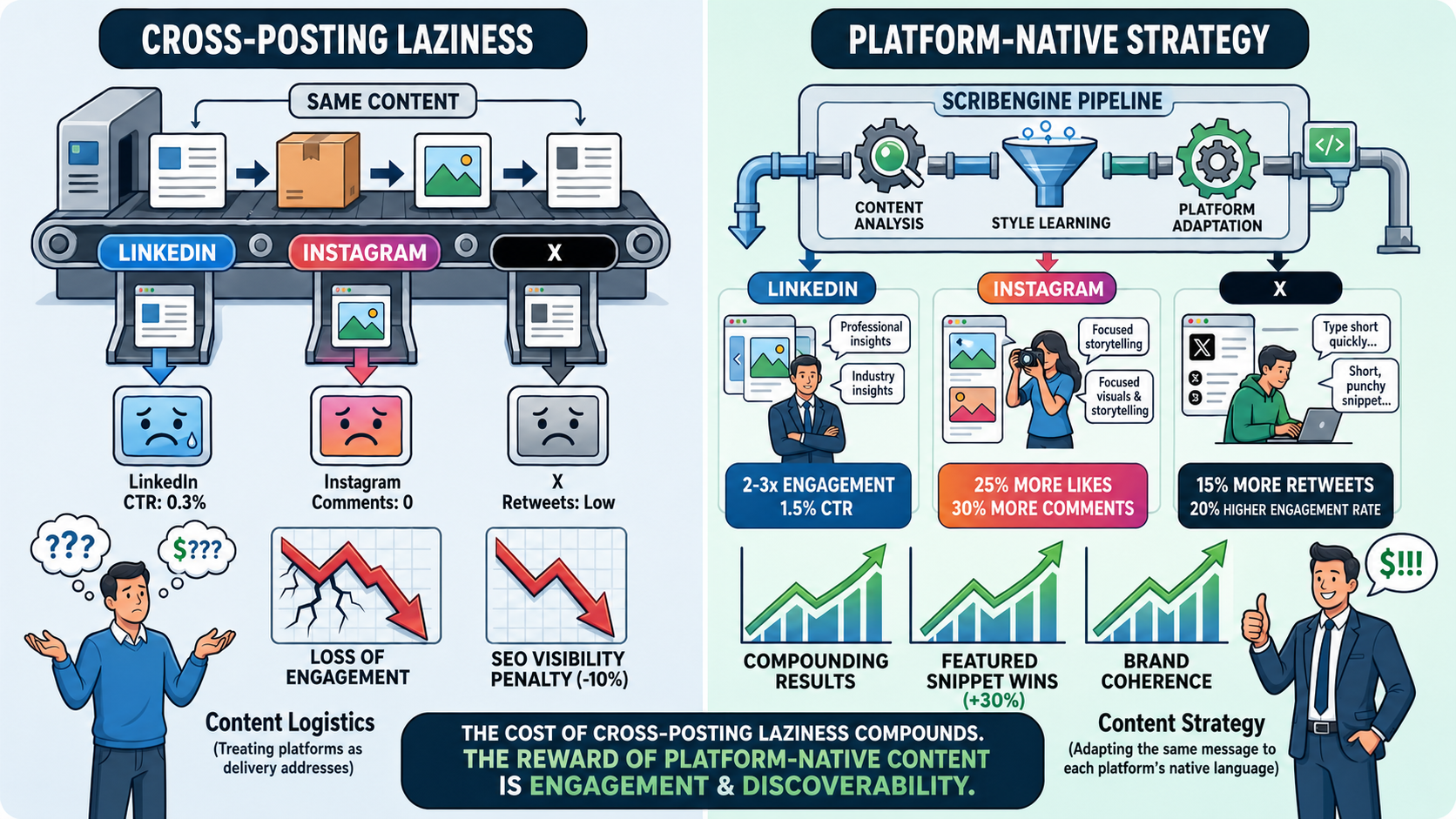
A client of mine — mid-sized DTC skincare brand, competent in-house team — spent three months posting the same content across LinkedIn, Instagram, and X with minor caption tweaks. Professional copy. Good photography. Consistent brand voice. Their LinkedIn CTR sat at 0.3%. Instagram comments were nearly zero. On X, their posts were getting fewer retweets than a press release from a company nobody had heard of. They came to me convinced the problem was their product messaging.
It wasn't. The problem was that they were treating three fundamentally different distribution environments as three delivery addresses for the same package. Repurposed content earns 25% fewer likes on Instagram and 15% fewer retweets on X compared to native content — and on top of those engagement losses, Google flags repurposed material with up to 10% lower search visibility. The cost of cross-posting laziness is not theoretical. It compounds.
The Anatomy of a Platform Fail
After six years managing content calendars for 15 to 20 e-commerce clients simultaneously, I stopped guessing why repurposed posts underperformed and started measuring it. What I found was not a messaging problem. It was a context problem — and context determines whether anyone reads a single word.
Here's what the numbers actually look like:
| Platform | Native Content Advantage | Key Format Driver |
|---|---|---|
| LinkedIn | 2–3x engagement vs. repurposed posts; 1.5% avg CTR | Carousels average 3x dwell time of static images (scroll-stop events weighted by feed algorithm) |
| Instagram | 25% more likes, 30% more comments | Visually structured posts; algorithm weights saves and shares over likes |
| X | 15% more retweets, 20% higher engagement rate | Compression and timing; sub-280-character native voice outperforms truncated long-form |
Platform-native content also earns Google's featured snippets 30% more often than repurposed counterparts. If you're trying to write blog posts that rank and drive social engagement, the format decision is part of the SEO strategy, not separate from it.
The failure mode I watched repeat across dozens of accounts was always the same: a brand would write content — often a solid blog post, or sharp website writing — and then distribute it sideways across platforms without any structural adaptation. The LinkedIn version was too long and hashtag-heavy for its professional audience. The Instagram version was text-dense in a visual environment. The X version was a paragraph crammed into a character limit it wasn't designed for.
Repurposed content suffers 10% lower search visibility on top of those engagement losses. That's not just a social media problem. That's a discoverability problem.
Before/After: The Same Idea, Three Different Contexts
To make this concrete, here's what platform-native production actually looks like versus a standard repurpose job — using a hypothetical product launch announcement for a DTC brand:
Original (cross-posted verbatim):
"Excited to announce our new SPF50 serum is now available. Shop the link in bio. Great for all skin types. #skincare #beauty #SPF"
LinkedIn (Scribengine-optimized):
"We've been formulating our SPF50 serum for 18 months. Three rounds of clinical testing. Two reformulations based on consumer panel feedback. Here's what we learned about why most SPF serums fail on darker skin tones — and what we did differently." [Followed by a five-slide carousel breaking down the formulation story, ending with a soft product CTA]
Instagram (Scribengine-optimized):
Single hero image, no text overlay. Caption: "18 months. 3 clinical trials. 1 formula that doesn't white-cast." Three-word hook, then a line break, then social proof in the comments thread.
X (Scribengine-optimized):
"Most SPF serums fail on deeper skin tones because they prioritize UV scatter over formulation stability. We fixed that. Here's the thread." — then a three-tweet breakdown, each under 240 characters.
The underlying message — we made a better SPF — is identical. The writing style, structure, and native behavior of each post are completely different. That's the delta between content logistics and content strategy.
Why Platform-Native Content Is a Distribution Strategy, Not a Formatting Preference
The most persistent misconception I encounter — from clients, from other consultants, from people who write blog posts about social media for a living — is that platform adaptation is a cosmetic exercise. Add some emojis, shorten the copy, slap a hashtag on it. Done.
No.
LinkedIn's feed algorithm weights scroll-stop events. Carousel posts generate approximately 3x the dwell time of static images because each swipe is a micro-engagement signal the algorithm reads as interest. That's not a formatting preference. That's a distribution mechanic.
Instagram's algorithm weights saves and shares more heavily than likes as of its most recent ranking update — which means emotionally resonant, visually structured content that people bookmark for later outperforms content designed for immediate reactions. A dense block of text repurposed from a LinkedIn post is not going to get saved.
On X, the compression of the format is the point. Native X voice is punchy, conversational, and built around the thread mechanic — not truncated long-form. Platform-native content on X earns 20% higher engagement rates than adapted reposts because it reads like it was written for that environment, not translated into it.
Platform-native content isn't a formatting preference — it's a distribution strategy. Brands that treat LinkedIn, Instagram, and X as three delivery addresses for the same package aren't doing content marketing. They're doing content logistics.
A Note on Audience Overlap — and When This Actually Matters
Here's the uncomfortable part of this argument that most platform-native content articles skip: for small businesses and solo creators at sub-5,000 followers on any given platform, format optimization is a second-order problem.
If your LinkedIn following is 800 people and your Instagram is 400, the signal-to-noise ratio is too low for format differences to be the primary driver of performance. What moves the needle at that stage is consistency, topic clarity, and network effects. Buffer's own analysis — across 72,000 posts — found that replying to comments produces a 30% engagement boost on LinkedIn, independent of content format. That's a human behavior, not an AI output.
I'm not going to pretend otherwise: platform-native content optimization pays its biggest dividends when you already have audience traction to lose.
What it also does, at any follower count, is establish the production discipline that prevents you from building a following on one platform that then has no idea what to make of your content on another. The audience-overlap problem is real — followers who cross-follow a brand on LinkedIn and Instagram will notice when the LinkedIn post says "here's our three-year product roadmap" and the Instagram caption says "living our best SPF life 🌞." That's not differentiation. That's brand incoherence.
The fix isn't to write three completely different messages. It's to adapt the same strategic message to each platform's native language — different format, consistent underlying point of view.
Scribengine: Production Infrastructure, Not a Tool Upgrade
Here's how most brands currently use AI to write content: they open a general-purpose text generator, type a prompt, get output, edit it manually for each platform, and publish. The result is content that is faster to produce and equally bad at being native to any environment.
Scribengine is structured differently — and the difference is in the pipeline, not the interface. Content Marketing Institute users reported a 50% increase in readability and coherence when using Scribengine versus raw single-prompt AI outputs, because the multi-stage process catches what a single generation pass misses: tone calibration, format compliance, audience-specific language, and brand voice consistency.
Here's how the production sequence actually works:
Stage 1 — Content Analysis
Input: your brief, your existing brand voice samples, target platform. The system runs a content analysis pass — not just keyword extraction, but structural pattern matching against what performs natively on each platform. LinkedIn carousel or long-form? Instagram caption-first or visual-first? X thread or single post? The format decision happens here, based on the specific content type, not a generic template.
Stage 2 — Style Learning
Scribengine's style learning doesn't mean "it sounds sort of like you." It means it reads the tonal patterns in your existing content — sentence length, vocabulary register, how you handle transitions, whether you use first-person or second-person — and replicates those patterns in the generated output. The Content Marketing Institute finding (50% readability improvement over raw AI output) comes from this stage: it's what separates usable content from content that needs a complete rewrite before it can go anywhere.
Incorporating culturally relevant language and platform-specific nuance into this stage can enhance user affinity by as much as 30%, according to user behavior research — because "native" isn't just format-deep. It's also about whether the content sounds like it was written by someone who actually uses that platform.
Stage 3 — Platform-Specific Output
The final output isn't a single piece of content with three export options. It's three distinct pieces, each built to the mechanical requirements of its platform: character limits, carousel structure, hashtag strategy, and visual/text ratio guidance for the Instagram version. The LinkedIn version is structured for dwell time. The Instagram version is structured for saves. The X version is structured for thread engagement and retweet velocity.
This is what it means to write content at the infrastructure level rather than the execution level. The platform-native production is baked into the process, not applied afterward as a formatting pass.
What the Algorithm Actually Rewards — Platform by Platform
LinkedIn's feed algorithm rewards dwell time and meaningful engagement — comments and shares weighted more than reactions. This is why thought leadership posts with a narrative arc (problem → insight → implication) outperform announcement posts with no structural tension. It's also why carousels work: each card swipe is a signal.
The 1.5% CTR benchmark for platform-native LinkedIn content versus the sub-0.5% typical of repurposed posts isn't a small delta. At scale, that's the difference between a content program that drives pipeline and one that generates impressions that nobody on the sales team can point to.
LinkedIn's median engagement rate has climbed to 8% as of early 2025 — which tells you the platform is rewarding authentic professional voice. The ceiling is higher than it was. The floor for lazy repurposing is also lower.
Instagram's current ranking signals weight saves and shares over likes. What this means practically: content optimized for an immediate like — a pretty image, a feel-good caption — is less algorithmically valuable than content that earns a "save for later" behavior. Educational carousels, step-by-step visual guides, and high-value caption content all trigger saves more reliably than pure brand aesthetic content.
When you write blog posts or long-form website writing and then compress that content into an Instagram carousel — not copy-paste, but genuinely restructured for a swipe-through format — you're converting your research investment into an Instagram-native asset. That's a different production decision than adding a quote card.
X
X's engagement mechanics reward compression and timing. The platform's native voice is built around the thread — a sequenced argument across linked posts — not truncated single posts. When a brand posts a paragraph broken at 280 characters, the lack of native formatting is visible. It reads like a translation, not a conversation.
Platform-native content on X earns 20% higher engagement rates than repurposed material. The mechanism is simple: native posts are written in the format, not adapted to it. The difference is audible to anyone who spends regular time on the platform.
The SEO Layer Nobody Talks About
Most of this conversation happens in the social media silo, which is where the first mistake gets made.
Platform-native content earns Google's featured snippets 30% more often than repurposed content. Which means if you're trying to write blog posts that rank, your social content strategy is also your SEO content strategy — and the discipline of creating native, high-value content for each platform builds the kind of topical authority that search engines reward.
Repurposed content signals to search engines what it signals to platform algorithms: this was not made for this context. The 10% lower visibility penalty for repurposed content in search isn't punitive. It's a relevance score. Content that isn't native to its environment is structurally less useful to a reader arriving from search, and Google has gotten better at measuring that.
The brands that consistently earn featured snippets — that show up in AI Overviews, that win the comparison table results — are producing content that is structurally designed for the question-and-answer format of search. That's a different writing discipline than brand-voice social content. Scribengine's content analysis stage maps to both requirements, which is why it functions as production infrastructure rather than a copywriting shortcut.
On Writing Style and What "Native" Actually Means
There are several recognized writing styles — expository, persuasive, narrative, descriptive, technical — but platform-native content requires something more specific: an understanding of register, which is the relationship between the writer, the audience, and the context.
LinkedIn register is professional-credible: first-person, evidence-anchored, point-of-view-forward. Instagram register is visual-first, emotionally resonant, concise. X register is conversational, compressed, argumentative. The same writer with the same ideas needs to shift register across all three to communicate effectively — and most AI generate content tools don't account for register at all. They account for length.
This is also why the "7 types of writing styles" framing that appears frequently in content education is useful but incomplete. Narrative writing on Instagram is different from narrative writing in a long-form blog post, even though both are "narrative." The platform context changes what narrative means. A blog post with a first-person story arc performs differently than an Instagram caption with the same arc compressed into four lines — not because one is better writing, but because the reader's relationship to the format is different.
Scribengine's style learning accounts for register, not just tone. That's the distinction that matters.
The Production Economics
Here's where the agency-versus-DIY argument usually goes wrong: it treats quality and speed as the only variables.
Agencies charge $2,000 to $4,000 per project. Their reliability is undeniable — but at that price point, most small businesses can commission two to three content projects per quarter, which is not a content program. It's a content event.
DIY AI tools run $30 to $100 per month. They produce content quickly. They do not produce platform-native content — they produce text that requires significant editing before it fits any specific environment, which means the time savings evaporate in the revision pass.
Scribengine operates at $300 to $500 per project — with a 30% reduction in production time compared to the full agency process. For a small business running a genuine multi-platform content program, that math closes the gap between "we can afford to test this" and "we can afford to maintain this."
The $5 trial is not a subscription. It's a single production run — your actual content, your actual brand voice, your actual platforms — so you can see the before-and-after without committing to a workflow change before you've verified it works for your specific context.
One More Thing About "Platform-Native" at Small Scale
I want to address the objection that practitioners at smaller follower counts are already raising internally while reading this: does any of this matter if you have 900 LinkedIn followers and 500 Instagram followers?
Partially.
The engagement percentage gains — 2-3x on LinkedIn, 25-30% on Instagram — are real but they apply to a smaller absolute number at low follower counts. You're not losing thousands of impressions to lazy repurposing. You're losing dozens.
What you are building with platform-native production discipline is a content program that scales correctly. The clients I've seen grow audiences from 800 to 15,000 on LinkedIn in 18 months weren't doing anything dramatically different from clients who stayed flat. They were doing the same things more consistently, with better format calibration from the start. Platform-native production is what makes consistency compound.
It's also what prevents the brand incoherence problem: followers who cross-follow you on multiple platforms should experience a coherent point of view expressed in different native languages — not three versions of the same message that read like they were written by three different people who've never met.
The Bottom Line
Platform-native content isn't a formatting preference. It's the difference between content that earns distribution and content that gets filed under "we posted today."
The brands that consistently outperform on LinkedIn, Instagram, and X aren't producing more content. They're producing content that is structurally built for the context it enters. LinkedIn carousels earn 3x the dwell time of static images because the algorithm weights scroll-stop events — not because someone remembered to add five slides. Instagram native content earns 30% more comments because it was built for the save behavior, not the like behavior.
And the compounding effect — higher platform engagement, 30% more featured snippet wins in search, 10% better baseline visibility — means platform-native production is not a social media optimization. It's a distribution strategy with SEO implications.
If you've been treating your blog posts, website writing, and social content as parallel outputs of the same production process, the engagement data is telling you something worth hearing.
The $5 Scribengine trial runs your actual content through the full multi-stage pipeline — content analysis, style learning, platform-specific output — so you can compare the before and after yourself. Not a subscription. Not a commitment. Just a production run against a real brief, with real output, at a cost that makes the test trivially low-risk.
The alternative is another quarter of posting content that earns impressions nobody on your team can explain.
Published by
Scribengine Team